In steel members without fire protection, the temperature rises quickly during a fire. The time to reach the critical temperature depends on the thermal properties of steel, on the geometry of the section and on the fire exposure conditions.
How does unprotected steel heat up?
Steel has a high thermal conductivity. For this reason, in common steel members the temperature can be taken as uniform over the whole cross-section.
The heating rate depends mainly on the ratio between the surface area exposed to fire and the volume of the member, that is on the section factor Am/V.
The higher the section factor, the faster the member heats up. Thin-walled sections reach the critical temperature sooner than stocky sections.
Calculating the steel temperature
According to EN 1993-1-2, cl. 4.2.5.1, the temperature increase of an unprotected steel member is determined incrementally, for each time step Δt:
The steel temperature at the end of the time step is:
Net heat flux
Heat reaches the steel member by convection and radiation:
The gas temperature θg follows from the fire curve adopted. For the ISO 834 standard curve, the coefficient of heat transfer by convection is αc = 25 W/(m²K).
The calculation in this guide uses εm = 0.7 and εf = 1.0.
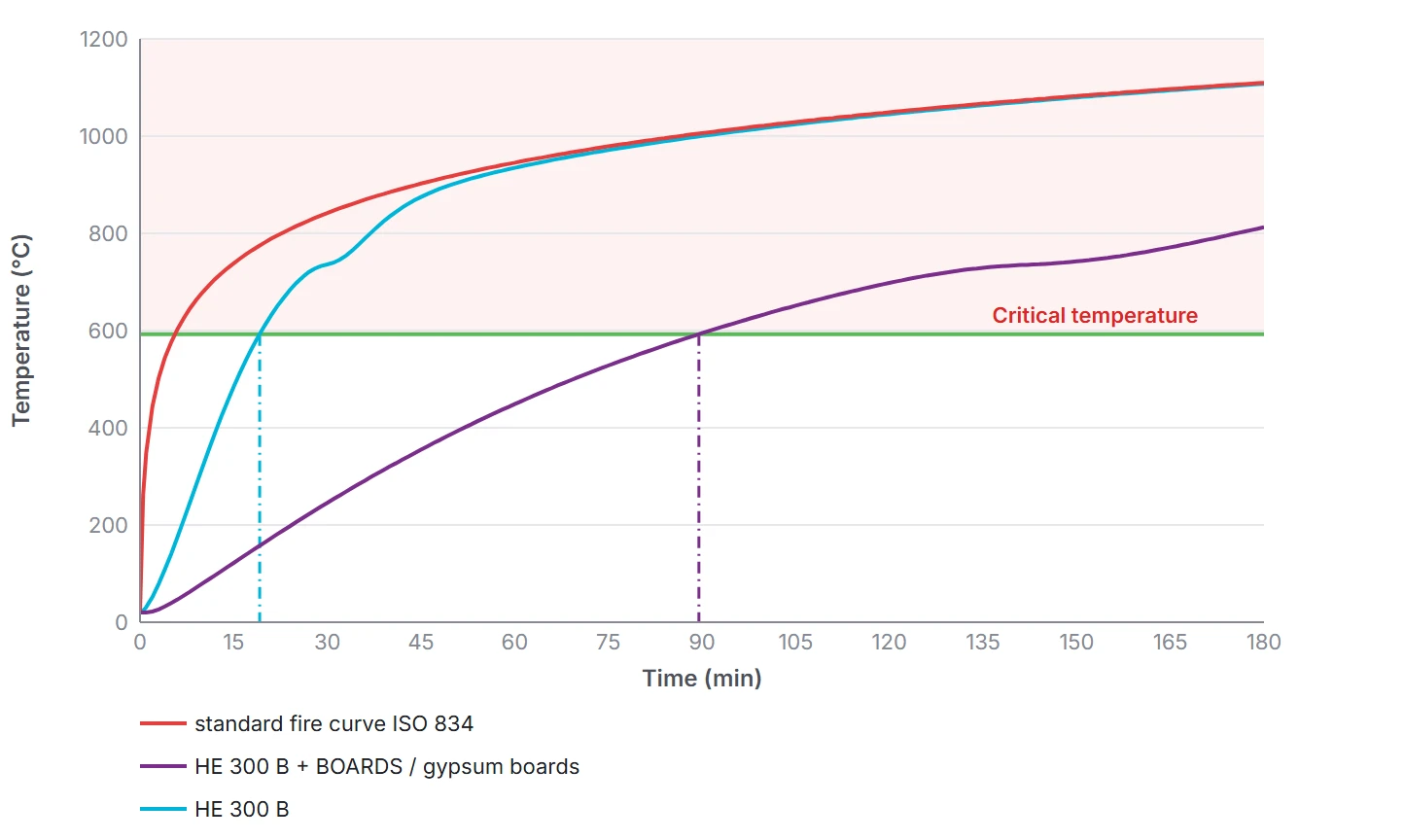
The specific heat of steel ca varies with temperature and changes the heating rate. It has a sharp peak around 735 °C, where the rise in steel temperature slows down for a while.
Section factor and shadow effect
The section factor Am/V is the ratio between the surface area through which the member receives heat and its volume.
In some sections, the shape of the cross-section creates a shadow effect that changes the distribution of the heat flux. This effect is taken into account by the shadow factor ksh.
The calculation uses the modified section factor:
I and H sections
For I and H sections exposed on three or four sides, the shadow factor is given by the expression in EN 1993-1-2:
(Am/V)b is the section factor of the section idealised as a rectangular box.
Hollow sections
For circular, square or rectangular hollow sections exposed all round, ksh = 1.0. In this case, the modified section factor equals the geometric section factor.
Example: HEB 300 section
An HEB 300 exposed on four sides has Am/V = 116 m−1. With a shadow factor ksh = 0.62, (Am/V)mod = 72 m−1.
A lower modified section factor means slower heating of the member.
Time to reach the critical temperature
The fire resistance time of an unprotected member can be estimated as the moment when the steel temperature reaches the critical temperature θa,cr.
The critical temperature depends on the degree of utilisation of the member and on the type of structural verification in the fire situation.
The table below gives the heating times, in minutes, for different values of the modified section factor and for representative steel temperatures. The values are computed step by step with eq. (4.25), under the ISO 834 curve.
Time for unprotected steel to reach a given temperature
| ksh·Am/V [m−1] | 450 °C | 500 °C | 550 °C | 600 °C | 650 °C | 700 °C |
|---|---|---|---|---|---|---|
| 50 | 17.5 | 19.5 | 21.8 | 24.3 | 27.2 | 30.8 |
| 100 | 11.4 | 12.8 | 14.4 | 16.3 | 18.5 | 21.5 |
| 150 | 9.0 | 10.2 | 11.5 | 13.2 | 15.2 | 18.0 |
| 200 | 7.7 | 8.7 | 9.9 | 11.4 | 13.3 | 16.1 |
| 250 | 6.8 | 7.7 | 8.8 | 10.3 | 12.2 | 15.0 |
| 300 | 6.1 | 7.0 | 8.1 | 9.4 | 11.3 | 14.3 |
Intermediate values may be interpolated.
The values in the table are the times needed to reach the stated temperature, not fire resistance classes guaranteed for any structural member.
Implications for fire design
The fire resistance of unprotected steel members depends mainly on the modified section factor and on the critical temperature that follows from the structural verification.
- Sections with a high section factor heat up quickly and can reach the critical temperature in the first minutes of the fire.
- Stocky sections have a higher thermal inertia and can reach longer fire resistance times.
- Members with a low degree of utilisation allow higher critical temperatures, so they can reach longer fire resistance times.
- Classes such as R 60 or R 90 generally require passive fire protection.
The time to reach the critical temperature is determined for each member, from the properties of its section and the design effects of actions in the fire situation.
Informative material based on EN 1993-1-2. It does not replace the text of the standard, the National Annex or verification by a qualified engineer.