Two ways of applying protection
- Sprayed coatings (based on mineral fibre, vermiculite or perlite) follow the contour of the section. The section factor of the protected member is the contour one: Ap/V = perimeter / area.
- Boards (gypsum, calcium silicate, vermiculite, fibre cement) form a box around the section. The section factor is that of the box: Ap/V = 2(h + b) / area for four-sided exposure.
For I/H sections the box has a much smaller surface than the contour: for an HEB 300, 80.5 m−1 instead of 116.2 m−1. For hollow sections the two are practically equal.
Thermal properties of the materials
Heating of protected steel (EN 1993-1-2, eq. 4.27) depends on the thermal conductivity λp, density ρp and specific heat cp of the protection. Indicative values from the literature (ECCS):
| Material | Application | ρp [kg/m³] | λp [W/mK] | cp [J/kgK] |
|---|---|---|---|---|
| Spray: mineral fibre | contour | 300 | 0.12 | 1200 |
| Spray: vermiculite cement | contour | 350 | 0.12 | 1200 |
| High-density spray: vermiculite + cement | contour | 550 | 0.12 | 1100 |
| Gypsum boards | box | 800 | 0.20 | 1700 |
| Vermiculite + cement boards | box | 800 | 0.20 | 1200 |
| Fibre-silicate / calcium-silicate boards | box | 600 | 0.15 | 1200 |
| Fibre-cement boards | box | 800 | 0.15 | 1200 |
For a project, use the values declared by the manufacturer, obtained from tests to the EN 13381 series. The app starts from the values above and lets you define your own materials.
Thicknesses compared for the same section
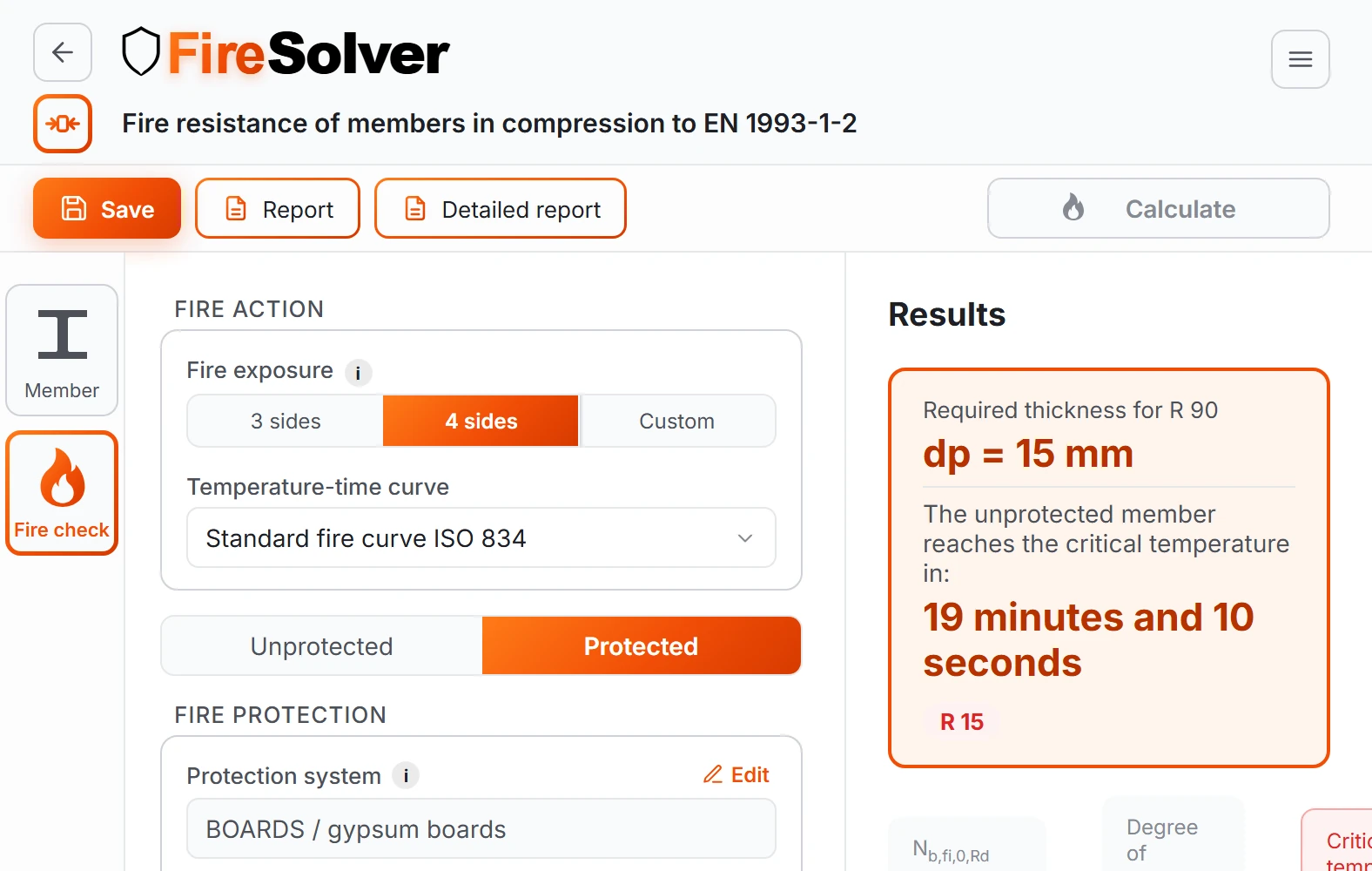
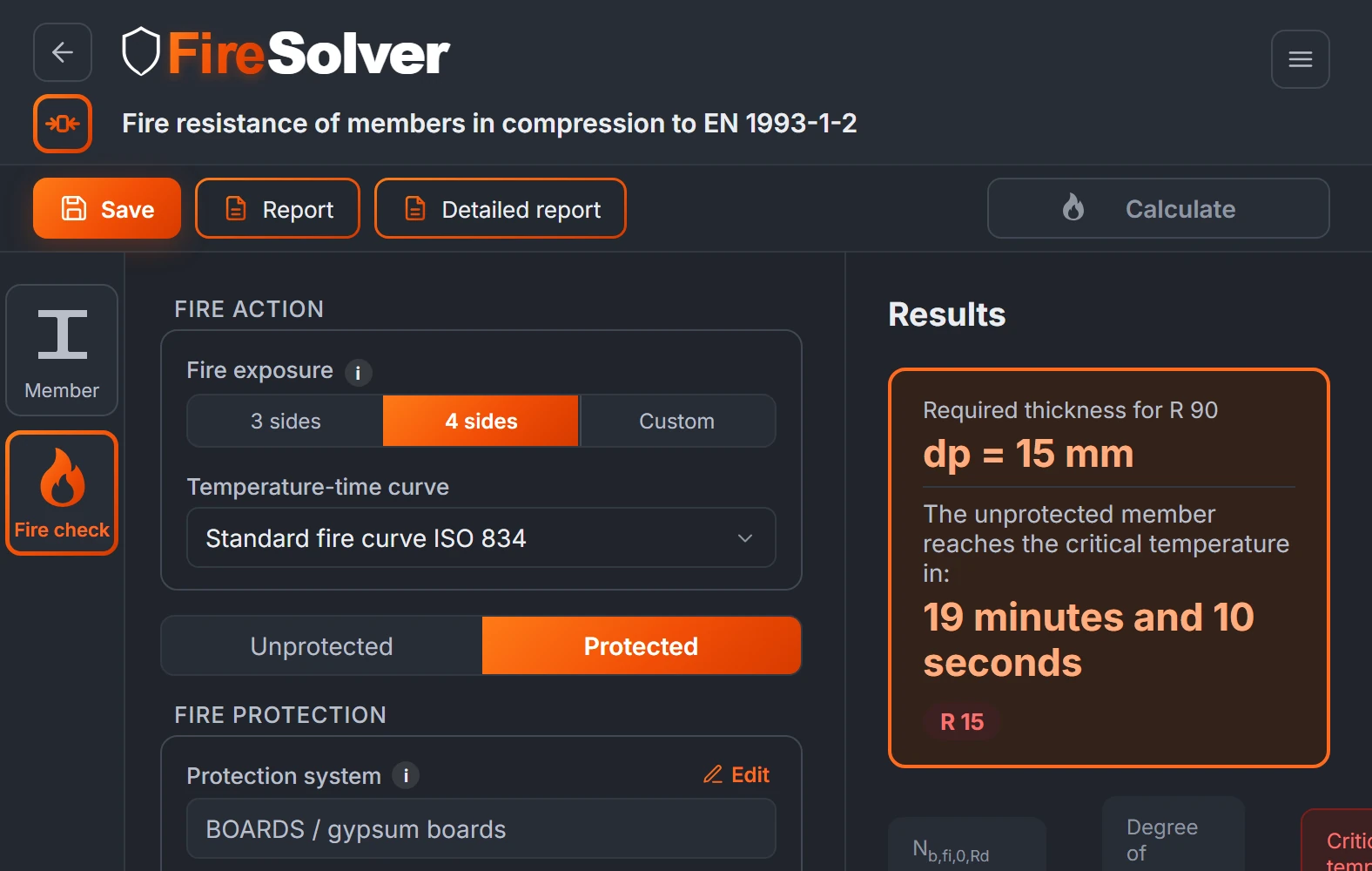
The thickness required for the column in the worked example (HEB 300, S355, exposed on four sides, critical temperature 592.6 °C), under the ISO 834 curve, rounded up to 0.5 mm:
| Material | Ap/V [m−1] | R 30 [mm] | R 60 [mm] | R 90 [mm] | R 120 [mm] |
|---|---|---|---|---|---|
| Spray: mineral fibre | 116.2 | 3.5 | 9.0 | 14.5 | 20.5 |
| Spray: vermiculite cement | 116.2 | 3.5 | 8.5 | 14.5 | 20.0 |
| High-density spray: vermiculite + cement | 116.2 | 3.5 | 8.5 | 14.0 | 19.5 |
| Gypsum boards | 80.5 | 4.0 | 9.5 | 15.0 | 21.0 |
| Vermiculite + cement boards | 80.5 | 4.0 | 10.0 | 16.0 | 22.0 |
| Fibre-silicate / calcium-silicate boards | 80.5 | 3.0 | 7.5 | 12.5 | 17.5 |
| Fibre-cement boards | 80.5 | 3.0 | 7.5 | 12.0 | 17.0 |
What the comparison shows
- On the same section, the box Ap/V is 31% lower than the contour Ap/V. The boards in the table have a higher conductivity than the sprays (0.15 to 0.20 W/mK against 0.12 W/mK).
- Calcium silicate and fibre-cement boards need the smallest thickness. Gypsum and vermiculite boards need about the same thickness as the sprays.
- The thickness grows almost linearly with the required duration: 5 to 6 mm for every extra 30 minutes.
- Real thicknesses come in commercial steps (for example 12.5, 15, 20 or 25 mm boards), so the computed value is rounded to an available thickness.
Other selection criteria
- Sprays are quick to apply on complex shapes (connections, bracing), but leave a rough surface and need a clean, primed substrate.
- Boards give a clean finish, are installed dry and are easy to inspect on site, but need fixing details and more labour at connections.
Informative material summarising the provisions of EN 1993-1-2. It does not replace the text of the standard, the National Annex or verification by a qualified engineer.