Input data
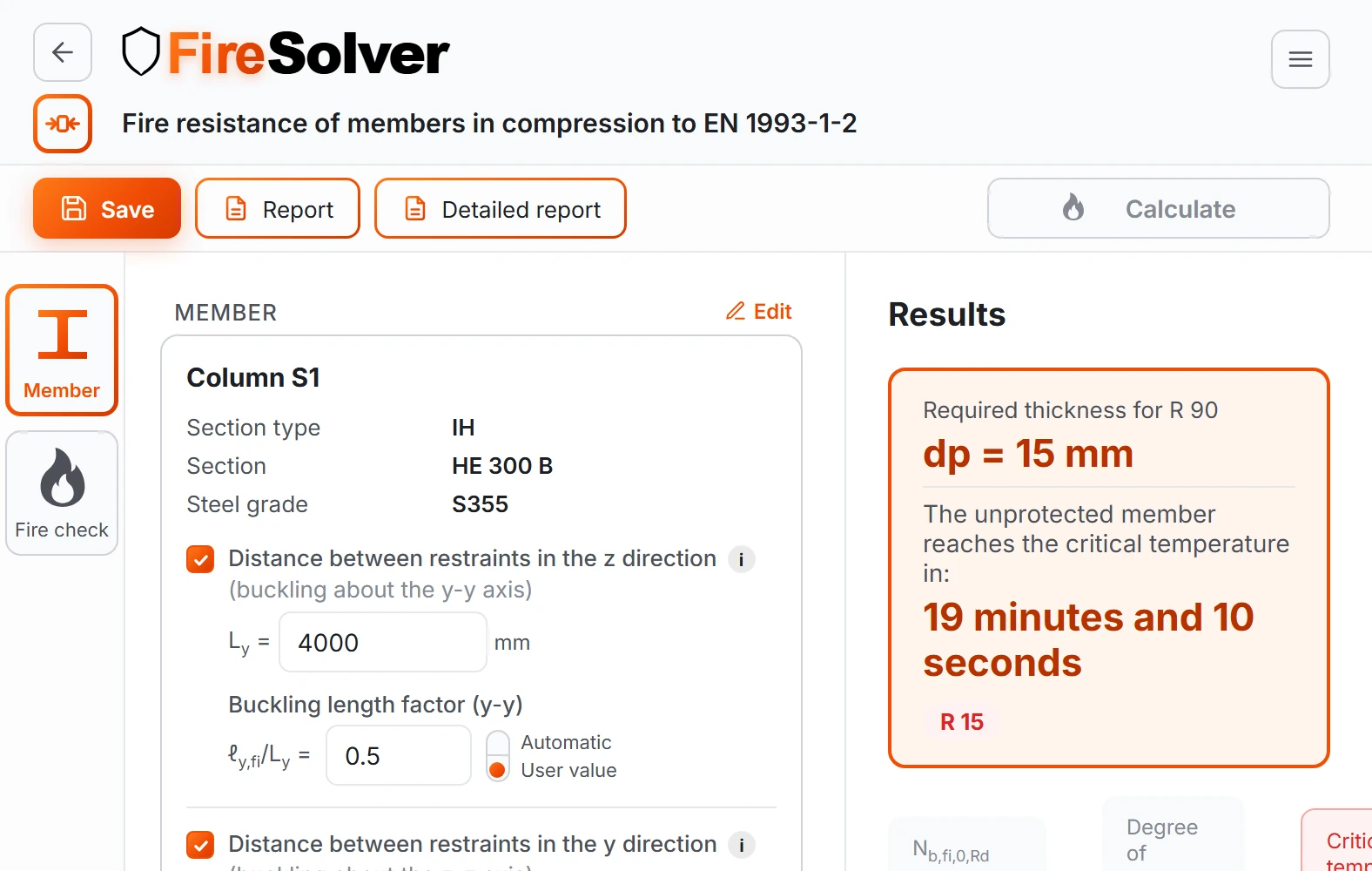
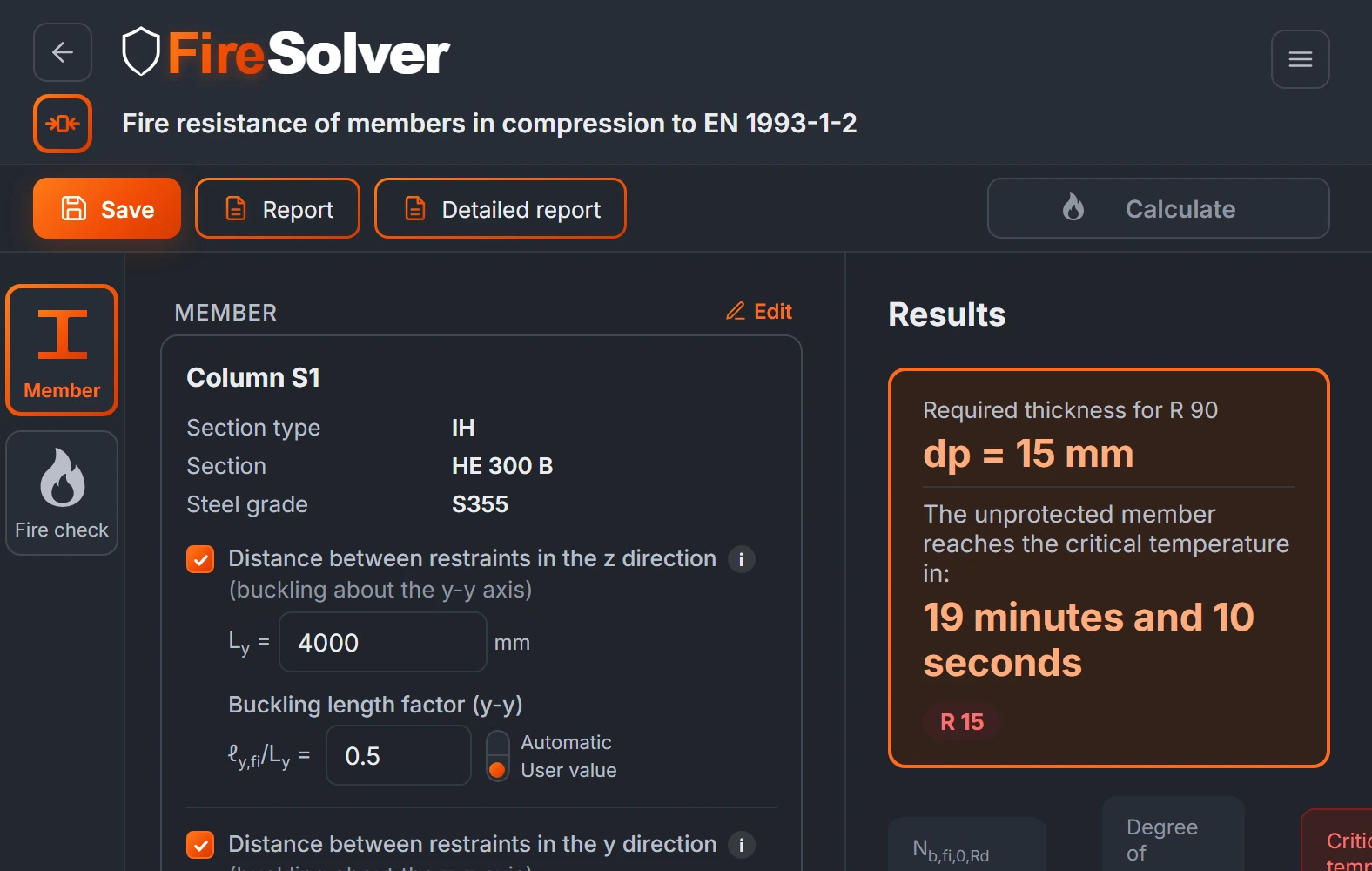
- HEB 300 (HE 300 B) column in S355, fy = 355 N/mm² (tf = 19 mm ≤ 40 mm), E = 210 000 N/mm².
- Storey height L = 4.00 m, braced frame, intermediate storey, each storey a separate fire compartment.
- Compression force in the fire situation Nfi,Ed = 2000 kN; γM,fi = 1.0.
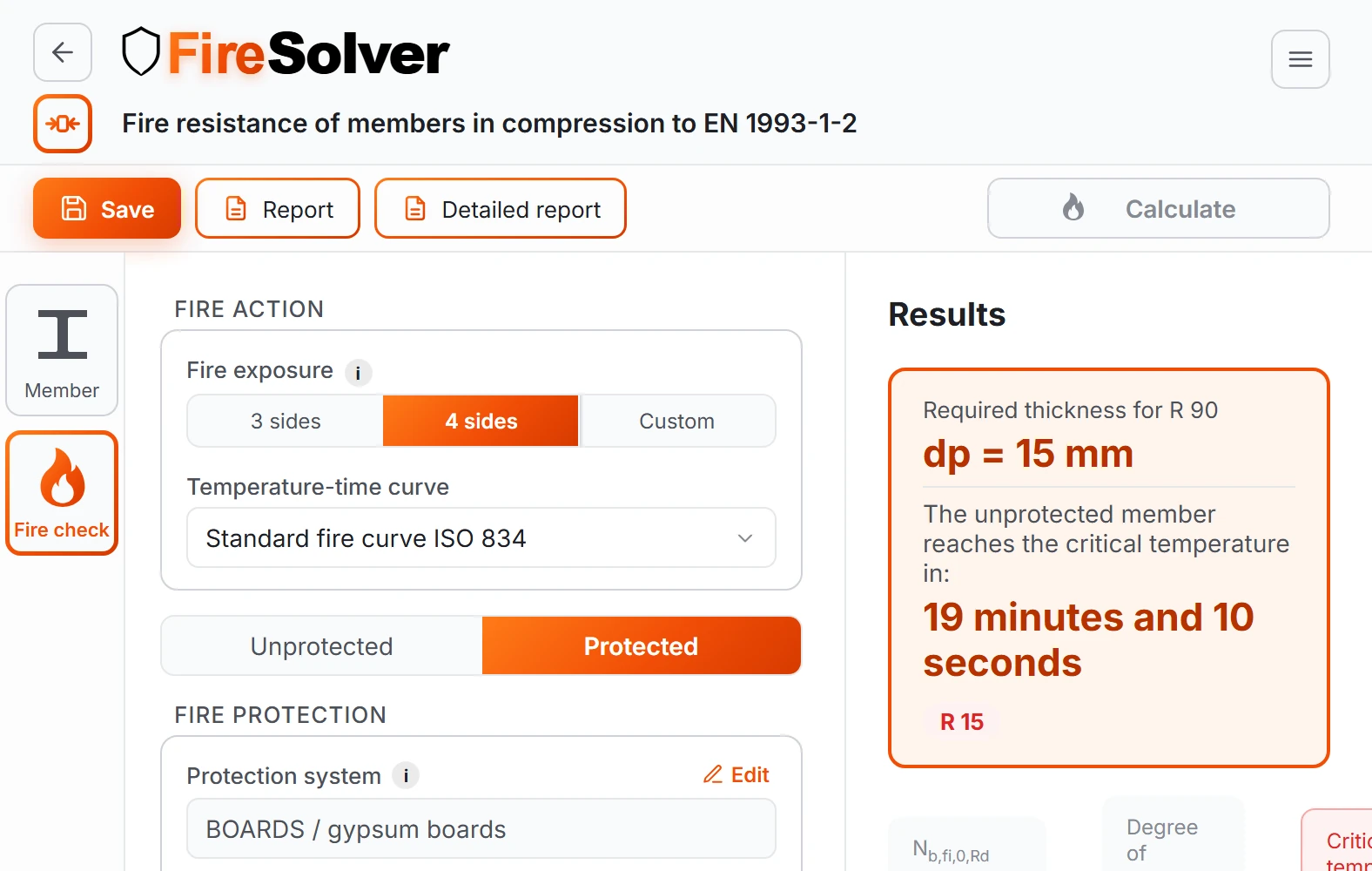
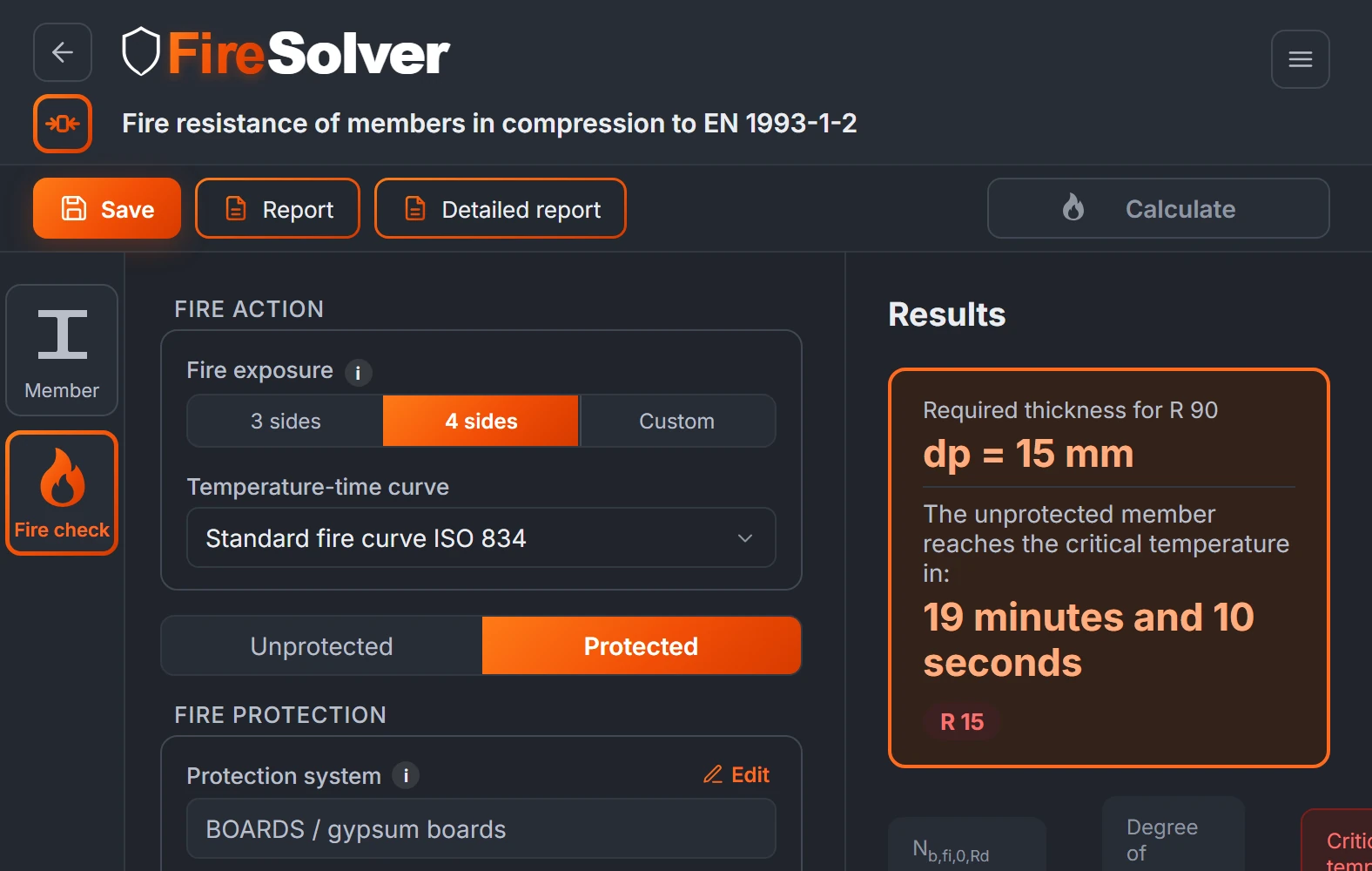
- Four-sided exposure, ISO 834 standard curve, required class R 90.
| Quantity | Value |
|---|---|
| h × b × tw × tf × r | 300 × 300 × 11 × 19 × 27 mm |
| A | 149.1 cm² |
| Iy / Iz | 25 170 / 8 563 cm⁴ |
| Am/V (contour, 4 sides) | 116.2 m−1 |
| [Am/V]b (box, 4 sides) | 80.5 m−1 |
1. Cross-section class
- Flange: c = (300 − 11 − 2·27) / 2 = 117.5 mm; c/tf = 6.18 ≤ 9ε = 6.22, so Class 1.
- Web: c = 300 − 2·19 − 2·27 = 208 mm; c/tw = 18.9 ≤ 33ε = 22.8, so Class 1.
The section is Class 1. Details in the guide on cross-section classes in fire.
2. Buckling length and slenderness
Braced frame, intermediate storey, a fire compartment on each storey: ℓfi = 0.5 · L = 2.00 m about both axes (cl. 4.2.3.2(4)).
3. Critical temperature from buckling
The critical temperature is found iteratively. For a temperature θ, compute the slenderness λ̄θ and the factor χfi, then the degree of utilisation μ = Nfi,Ed / (χfi · A · fy / γM,fi) and, from eq. (4.22), a new temperature. Repeat until the temperature stops changing.
| Quantity (at convergence) | Axis y-y | Axis z-z |
|---|---|---|
| ky,θ / kE,θ | 0.450 / 0.295 | 0.493 / 0.331 |
| λ̄θ | 0.249 | 0.421 |
| χfi | 0.878 | 0.794 |
| μ | 0.430 | 0.476 |
| θa,cr | 608.4 °C | 592.6 °C |
The minor axis governs: θa,cr = 592.6 °C. The values of ky,θ and kE,θ are interpolated from Table 3.1.
4. Resistance without protection
Integrating eq. (4.25) under the ISO 834 curve, the unprotected steel reaches 592.6 °C after 19.2 minutes. The unprotected column only achieves R 15, so it needs protection for R 90.
5. Protection thickness
Gypsum boards as a box (λp = 0.20 W/mK, ρp = 800 kg/m³, cp = 1700 J/kgK), Ap/V = 80.5 m−1. With eq. (4.27), the minimum thickness that keeps the steel below 592.6 °C:
| Class | R 60 | R 90 | R 120 |
|---|---|---|---|
| Required dp | 9.5 mm | 15.0 mm | 21.0 mm |
For R 90 a single 15 mm board layer is enough, provided the properties declared by the manufacturer are at least as good as the values used here. A comparison with other materials is in the guide on boards and sprays.
What affects the result
- With ℓfi = 0.7 · L (top storey), the slenderness increases and the critical temperature drops, so the protection gets thicker.
- A lower force raises the critical temperature: the same column under 1500 kN needs less protection.
- With three-sided exposure (a column against a wall), the section factor drops and heating is slower.
Informative material summarising the provisions of EN 1993-1-2. It does not replace the text of the standard, the National Annex or verification by a qualified engineer.